Isometrics: Many Methods, Many Adaptations – Understanding the Nuance of Prescription
For years, isometric training was often viewed as little more than a useful tool for pain management or a way to maintain strength when movement was limited. More recently, however, isometric exercise has experienced a resurgence, driven largely by exciting research into tendon adaptation. Unfortunately, as often happens in our industry, enthusiasm has sometimes outpaced nuance.
A growing number of coaches and clinicians have begun prescribing isometrics as though they are the optimal solution for every tendon, every athlete, and every training/adaptation goal. That interpretation misses an important point.
Not all tendon adaptations are the same.
The question should never be:
"Are isometrics good?"
Instead, the question should be:
"Which adaptation am I trying to achieve?"
The answer determines the prescription.
The Principle of Specific Adaptation
Every training method produces an adaptation that is specific to the mechanical stimulus applied.
Just as maximal strength, hypertrophy, speed, and endurance require different training methods, tendons also adapt differently depending on the type of loading they experience.
When discussing tendon training, it is useful to think of three distinct adaptive goals:
Tendon remodeling and collagen turnover
Tendon stiffness and force transmission
Elastic function and stretch-shortening cycle performance
These qualities overlap, but they are not interchangeable.
Adaptation 1: Tendon Remodeling and Collagen Synthesis
This is where the work of Dr. Keith Baar has made one of the most significant contributions to sports science.
Historically, tendon loading focused primarily on increasing force. Baar's laboratory has demonstrated that the duration of loading also plays a critical role in stimulating tendon adaptation.
His work centres on a property of tendon known as stress relaxation.
When a tendon is held under a constant load:
the initial collagen fibres experience high stress
over time, those fibres gradually relax
mechanical load redistributes throughout the tendon
previously underloaded collagen fibres begin carrying load
more tendon cells (tenocytes) receive a mechanical signal
Rather than repeatedly loading only the strongest collagen bundles, longer-duration isometric holds expose a greater proportion of the tendon to meaningful strain.
The result is increased stimulation of the cells responsible for collagen production and tissue remodelling.
This is particularly valuable when working with:
tendinopathy
post-operative tendon healing
deconditioned tendons
athletes returning from periods of unloading
maintaining tendon health during heavy competitive seasons (avoiding more of the same stress)
Current practical recommendations often involve accumulating approximately two minutes of total loading, such as:
4 × 30-second holds
6 × 20-second holds
8 × 15-second holds
The exact duration is less important than accumulating sufficient time under load (2 minutes) to allow stress relaxation to occur.
Importantly, the primary goal here is biological adaptation, not necessarily maximal mechanical performance.
Adaptation 2: Tendon Stiffness
Healthy athletic tendons have a different job.
During sprinting, jumping, cutting, throwing, and Olympic lifting, the tendon functions as an exceptionally efficient spring.
A stiffer tendon generally:
transfers force more rapidly
stretches less under load
wastes less mechanical energy
improves rate of force development
contributes to explosive performance
The current body of evidence still strongly supports heavy progressive resistance training as one of the most effective methods for increasing tendon stiffness.
Researchers including Arampatzis, Bohm, Magnusson, Kubo, and Wiesinger have consistently demonstrated improvements in tendon mechanical properties following high-load resistance training.
Heavy loading produces:
high tendon strain threshold
increased stiffness
improved force transmission
This explains why athletes competing in explosive sports—including sprinters, Olympic weightlifters, jump & sprint athletes—typically possess exceptionally stiff tendons.
This adaptation differs from simply increasing collagen turnover.
*A tendon can remodel biologically without achieving maximal stiffness.
*Likewise, a tendon can increase in size without proportionally increasing its stiffness.
These represent different physiological adaptations.
Adaptation 3: Elastic Function and Stretch-Shortening Cycle Performance
Movements in Rugby, Lacrosse, Soccer, Football and others change of direction sports do not occur under slow, controlled conditions.
Athletes must repeatedly absorb and release force in fractions of a second.
Plyometric training develops the following athletic qualities including:
rapid force absorption
elastic energy storage
reactive strength
tendon behaviour under high loading rates
neuromuscular timing
Recent systematic reviews and network meta-analyses suggest that plyometric training is particularly effective for increasing tendon cross-sectional area, while heavy resistance appears to remain superior for increasing tendon stiffness. *However, more research needs to be done whereby readers can ‘see’ how the plyometrics were done. Unfortunately many studies report athletes completing pprograms but there is no reporting of their technique or who supervised their technique - technique often determines the result.
These adaptations appear complementary rather than competitive.
An athlete requires both.
The Mistake We Often Make
A common misconception is that increasing collagen synthesis automatically produces the stiffest, highest-performing tendon.
This is not necessarily true.
Collagen turnover, tendon stiffness, tendon size, elastic energy storage, and reactive performance represent related—but distinct—adaptations.
Different loading strategies preferentially develop different qualities.
As coaches, our responsibility is to prescribe the right stimulus for the desired outcome rather than assuming one exercise solves every problem.
Putting It Into Practice
Rather than asking whether isometrics should be included: ask what you want them to accomplish.
If the goal is tendon remodeling
Consider:
long-duration yielding isometrics
moderate to high effort
approximately two minutes of total loading
Ideal for:
painful tendons
rehabilitation
post-operative athletes
maintaining tendon health (*good for periods where team sport athletes might be loading their tendons a lot)
If the goal is: tendon stiffness
Prioritise:
heavy progressive resistance using grind lifts (squats, deads, bench)
high tendon strain
If the goal is explosive performance
Prioritise:
sprinting
plyometrics
These methods teach the tendon to store and release elastic energy rapidly under sporting conditions.
What About Alex Natera's Work?
Dr. Alex Natera has become one of the leading voices in applying isometric training to high-performance sport. While Dr. Keith Baar has advanced our understanding of tendon biology and collagen remodeling, Natera has focused on using isometrics to improve force production, tendon stiffness, and athletic performance. At first glance, their recommendations appear different, but they are actually addressing different physiological questions.
One of Natera's key messages is that not all isometrics are created equal. Changing the duration, intensity, intent, or execution of an isometric contraction changes the adaptation it produces. A 30-second yielding isometric prescribed for tendon remodeling is a completely different stimulus than a 5-second maximal overcoming isometric designed to produce high forces and improve athletic performance.
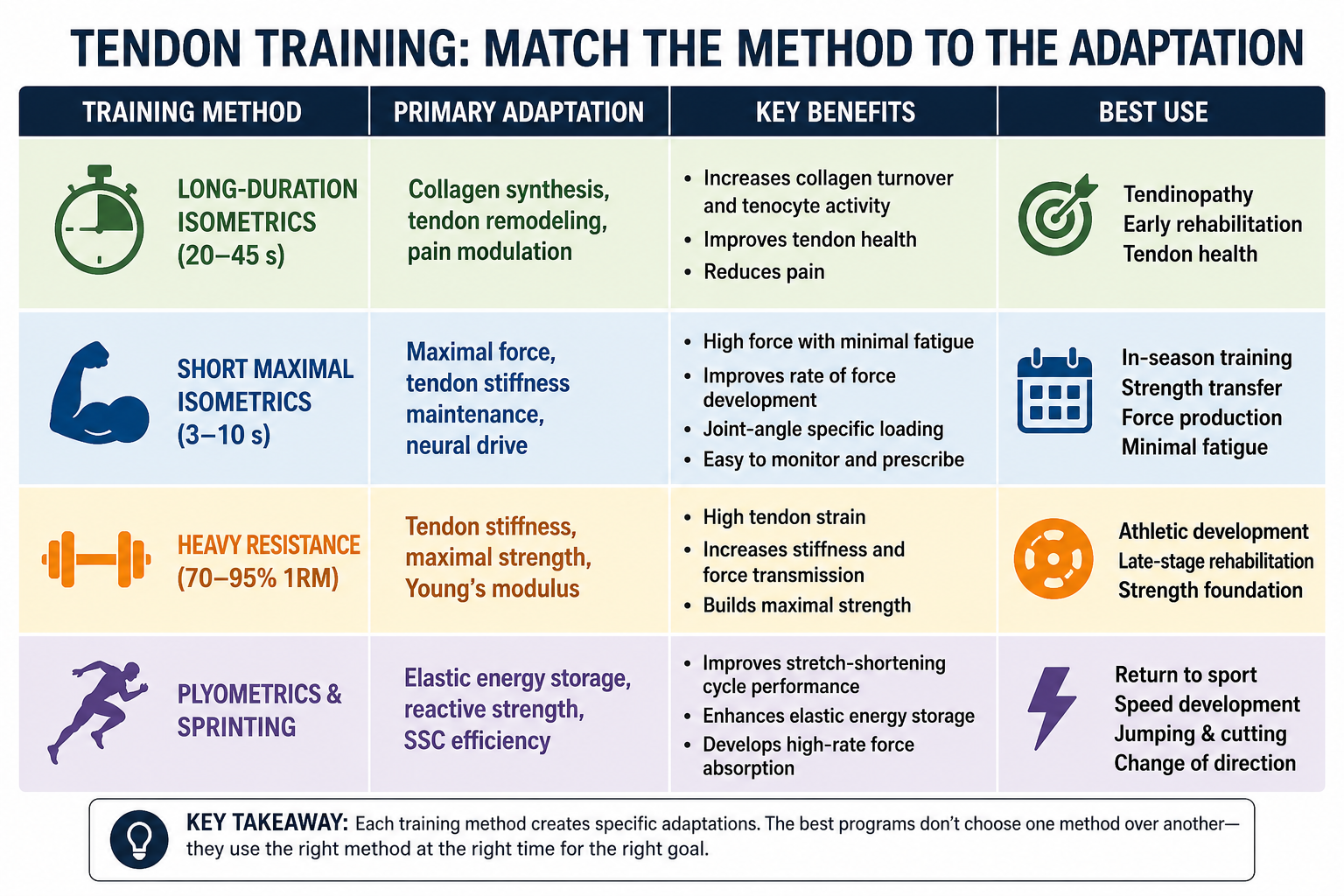
Short-duration maximal isometrics expose the tendon to extremely high forces while producing relatively little fatigue. They are commonly used to develop maximal force, improve rate of force development, maintain tendon stiffness during congested competition schedules, and target force production at specific joint angles. These qualities make them a valuable tool in the performance setting.
However, it is important not to overstate the evidence.
While research demonstrates that maximal isometric training can increase tendon stiffness, there is currently little evidence that it is superior to well-designed heavy resistance training when tendon strain is similar. In fact, the current body of evidence suggests that the tendon primarily responds to the magnitude, duration, and frequency of the mechanical strain it experiences, regardless of whether that strain is produced during an isometric, concentric, or eccentric contraction.
For healthy athletes, heavy progressive isotonic resistance training remains one of the most consistently supported methods for increasing tendon stiffness and improving force transmission. Likewise, plyometric training provides a unique stimulus by exposing the tendon to rapid loading rates that develop elastic energy storage, reactive strength, and stretch-shortening cycle performance—qualities that neither heavy resistance nor isometric training can fully replicate.
BOTH, teach the athlete how to MOVE.
Rather than asking which method is "best," coaches should ask a more useful question: What adaptation am I trying to achieve?
Long-duration isometrics appear particularly effective for tendon remodeling and collagen turnover. Short maximal isometrics are an excellent tool for force production and tendon loading with minimal fatigue. Heavy resistance remains fundamental for developing tendon stiffness, while plyometrics are essential for restoring the elastic function required for sprinting, jumping, and change of direction. The most effective programs don't choose one method over another—they use each where it is most appropriate.
Final Thoughts
Isometric training is neither overrated nor underrated. It’s a methodology. I think it is better to think about the tendon first, then choose the means to train it.
The recent work of Dr. Keith Baar has greatly improved our understanding of tendon biology, particularly the role of stress relaxation and long-duration loading in stimulating collagen remodeling. This was pivotal work for me when I do ACL rehab.
The most effective coaches recognize that tendon adaptation is multidimensional.
The best programs combine methods rather than searching for a single "best" exercise. And no coach that is worth their salt, proposes a single method as the be all, end all.
Because in high-performance sport, the question is rarely:
"What exercise should I use?"
The better question is:
"What adaptation am I trying to create?"
That answer should always drive the prescription.
References
Arampatzis, A., Karamanidis, K., & Albracht, K. (2007). Adaptational responses of the human Achilles tendon by modulation of the applied cyclic strain magnitude. Journal of Experimental Biology, 210(15), 2743–2753.
Baar, K. (2019). Stress relaxation and targeted mechanical loading for tendon adaptation. Journal of Applied Physiology (conceptual work and related publications).
Bohm, S., Mersmann, F., & Arampatzis, A. (2015). Human tendon adaptation in response to mechanical loading: A systematic review and meta-analysis. Sports Medicine, 45(5), 595–615.
Kubo, K., Kanehisa, H., & Fukunaga, T. (2002). Effects of resistance and stretching training programmes on tendon properties in vivo. Journal of Physiology, 538(1), 219–226.
Magnusson, S. P., & Kjaer, M. (2019). The impact of loading, unloading, ageing and injury on the human tendon. Journal of Physiology, 597(5), 1283–1298.
Rio, E., Kidgell, D., Purdam, C., et al. (2015). Isometric exercise induces analgesia and reduces inhibition in patellar tendinopathy. British Journal of Sports Medicine, 49(19), 1277–1283.
Wiesinger, H. P., Kösters, A., Müller, E., & Seynnes, O. R. (2015). Effects of increased loading on in vivo tendon properties: A systematic review. Medicine & Science in Sports & Exercise, 47(9), 1885–1895.